Touchdown at my mariscos Mecca

I have been remiss. Truly negligent. We often place more value on new experiences, than on the tried and true joys of everyday life. No mas! Few things bring me greater joy than savoring the bounty of the rolling blue expanse surrounding the Baja California peninsula with a cold beer. How have I not told you about this?!

We can debate exactly which altar of Baja seafood is the Cathedral of Mariscos. But in truth, any palapa-style establishment born to proud Paceños in La Paz, BCS, will deliver a sweet-fleshed, still-animate clam to your table in its roomy chocolate brown half shell home. There is little discernible difference because the ocean prepared the bite with exquisite seasoning, leaving little left for the Chef to do. The establishment has only to pry it open, slice the flesh, and provide a wedge of lime.

That said, one such Mariscos
restaurant in La Paz, Mariscos El Toro Güero, has worn a deep groove in my
culinary routine over the years. It is my homecoming parade each time I land on
Paceño soil. Every day from 10 am to 8 pm the expansive palapa shades hundreds
of locals and few strays like myself. Families celebrate, business men escape
the burning sun, and a constant rotation of musicians squeeze their instruments
through the narrow aisles soliciting an eager ear.

The everyday crowd at 3:30pm.

Along the back of the palapa, the kitchen staff slide heaping helpings of seafood through the pass to more than a dozen waiters who never cease to be in motion. Behind the pass, adept hands, worn and marred by constant battle with spiny, unrelenting ingredients, pick snow-white crab meat from pencil thin legs, negotiate resistant bivalves, peel the thin skins from electric blue shrimp, filet a technicolor assortment of fish, retrieve sea snails from deep recesses, and clean a boat load of octopus, squid, scallops and more. Peppers, onions, tomatoes, cucumbers, and lettuce are the humble flavoring elements used to add texture, brightness and heat to the star attractions. All of the evacuated shells find their way into a giant stew pot of what can only be described as the essence of Baja. With each order, a piping hot mug of this consommé lands on the table, instantly making one’s mouth water.

At the pass.

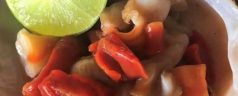
The menu is an anthology in Baja basics. There are dozens of varieties of tostada, empanada, taco, salad, soup, fried seafood, grilled fish, pate, ceviche, and even pasta, steak and burgers. Yet, I veer little from my groove opting for the Tostada Especial, a hard corn tortilla mounded with fresh diced crab, shrimp, octopus, and scallops mixed with the tiniest bit of sweet onion and cucumber. The mound is anchored to the tostada shell with a thin smear of mayo. I break off a loaded piece of the tostada and drizzle a salsa from the Pandora’s box of hot sauces on my table. In that moment, savoring the sweet flesh, fresh toppings, and kick of spice, I am home.

Tostada Especial piled high with fresh seafood.

When in season, the next move is
to order Chocolate clams (almejas chocolatas), a creature unmatched in its
sweetness and striking to the eye with its deep coral center. On cooler days, I
pair the seafood stew, which arrives with assorted mussels and shells including
crab legs reaching out from below the surface of the mahogany-colored broth. On
any day, I am likely to splurge on a single fried Marlin empanada oozing with
melted cheese. All around me, throngs of local patrons wash down their treats
with vibrantly tinted fruit juices and sodas. But, I opt to celebrate my
arrival with an ice-cold Modelo Especial.

Marlin empanada.

Despite the quality of service and opulence of ingredients, I step out of the deep shade into the heat of day with a dent in my wallet no larger than a Starbucks breakfast because… it is Mexico.

(Jamie Kelly)

El Toro Güero, La Paz, BCS
The intensely flavored seafood consommé comes with every meal upon request.
Select a sauce from Pandora’s box.
Almeja Chocolata (Chocolate clam)

Unearthing the secret lurking deep within the Barbacoa pit

Despite the linguistic similarity, Mexican barbacoa is not to be confused
with mere “barbecue” in which flames blister and char steaks, burgers and
hotdogs. No, Barbacoa is slow food at its finest. The dish is a ranch-born
exercise in pit-cooking patience.

Step 1: Dig a pit in the ground.

Step 2: Collect aged mesquite branches from the ranch floor with which to
fire up a batch of glowing coals.

Step 3: Shovel the coals into the pit and inter a large pot of seasoned
meat—be it lamb, beef or goat.

Step 4: Cover and wait, and wait, and wait. The Gods of barbacoa will
reward your patience.

Like all Mexican dishes, there are distinct regional varieties of barbacoa.
A traditional format from Northern Mexico calls for the whole head of a cow
wrapped in maguey leaves. The brains, eyes, jowls, sweetbreads, tongue and
other tasty bits steam gently in a delicious horror show. But, more commonly,
other cuts of meat are seasoned with dried chiles, garlic, onion, tomato, white
vinegar, and salt & pepper before they slowly steam/braise in earthy
convection.

The results are a fall apart, smoky meat and a concentrate of fat-fortified, spicy broth. The shredded meat rightly belongs nestled in a fresh corn tortilla warmed on a griddle and dipped in the broth. But, it is entirely acceptable as a torta, sandwiched within a warm bolillo bun. Nothing more than white onion, lime, and cilantro is needed to bring harmony to the unctuous meat filling. The taste? It is the essence of meat, with faint notes of smoke. Your mouth hums with chile heat, soothed by a thin coating of rendered fat, while the zing of lime, tomato and vinegar bounces off the sweet freshness of raw onion and cilantro balancing each bite.

A tortilla drenched in beef consommé for barbacoa tacos at Barbacoa Zain in Todos Santos, Baja California Sur, Mexico. (foto: Jamie Kelly)

Beef barbacoa

Barbacoa is a common dish for special gatherings in Mexico, but in Todos Santos (Baja California Sur), beef barbacoa is everyday breakfast. Yes, I said breakfast. At the street cart, Barbacoa Zain, the owner and his mother serve piping hot tacos and tortas on Calle Militar to throngs of locals who perch around the grill with mouths agape like baby birds. Shredded beef warms on the grill beside tortillas and chile peppers, while a large pot of simmering consommé made from the strained cooking broth waits to coat tortillas or to be dispersed into Styrofoam cups for sipping.

Beef barbacoa street tacos for breakfast at Barbacoa Zain in Todos Santos, Baja California Sur, Mexico (foto: Jamie Kelly)

In Queretaro, Mexico, north
of Mexico City, exists Restaurante Santiago, a venerable altar to the gods of
lamb barbacoa. Outside the restaurant, tortillas toast on the griddle as men
stand over a large wooden box (caja de china) lifting out layers of
precious cargo insulated by agave leaves. The aroma of intense woodsmoke
hits the passerby. One-by-one, pale pieces of seasoned goat meat, slow cooked
in a pit overnight, are extracted still glistening with their juices, tossed on
the chopping block, and quickly tucked into tortillas for the long line of
on-the-go eaters.

Lamb barbacoa on the chopping block for take-out tacos at Restaurante Santiago in Queretaro, Mexico (foto: Jamie Kelly)

Inside the cavernous restaurant, families convene around large tables and
an army of workers man large griddles covered with handmade tortillas,
quesadilla, molletes and more. Ordering is an unceremonious declaration of the
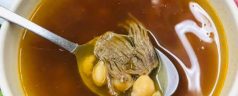
obvious: two barbacoa tacos and a bowl of consommé, the heavenly nectar that
results from hours of slow braising. When the consommé arrives, the
smell of campfire wafts from the translucent brown broth and a sunken treasure
of garbanzo beans lurks in its depths. The locals add onion, cilantro, and a
delicious guajillo salsa to the bowl, as if by muscle memory and then sip on
the thin liquid that delivers the intense essence of jerky. The tacos arrive
nestled between two layers of protective banana leaf. The first bite is as
perfect as first bites get. Smokey, meaty, tender, and surrounded by a corn
tortilla that absorbed the essence and offered a balancing sweetness.

Workers are in constant motion making tortillas and other sides for Restaurante Santiago's staring dish, lamb barbacoa. Querétaro, Mexico (foto: Jamie Kelly)

In San Diego, a restaurant called Aqui es Texcoco is the reigning authority on lamb barbacoa. Their lamb consommé, soup-up with soft and creamy garbanzo beans, is worth a visit alone. Yet, a contender for the crown is a little known and highly unorthodox barbacoa source in the City Heights neighborhood of San Diego. Candy Land Minimart is a mild mannered convenience store all week. But come the weekend, the shelves are pushed aside so that a tiny, makeshift kitchen can serve barbacoa to the hordes queued up outside. In addition to the usual taco format, Candy Land serves barbacoa taquitos (hard rolled tacos) smothered in crema and aged cotija cheese.

Lamb barbacoa ready for self-service tacos at Aqui es Texcoco, Chula Vista, California (foto: Jamie Kelly)

Still, my favorite barbacoa
experience to date, was at the modest home of a Todos Santeño family. As the
guests arrived, sheets of rusted corrugated metal were lifted from the home’s
front yard pit. A suitcase-sized tin foil wrapped package was exhumed from its
earthen kiln where it had braised since the wee morning hours. From where I
stood eagle-eyeing the process, I could see the steaming roasting pan carried
away into the home. Every fiber of my being screamed “follow that pan!” I
didn’t want to miss a secret of the Barbacoa process. But I minded my manners,
twitching through polite conversation and side-eying the door. At last, piping
hot bowls of shredded beef in red broth hit the table. We sat together in the
home’s front yard, the generous family, their long-time friends, family, and
one wide-eyed, seemingly ravenous gringa. Barbacoa has never tasted better.

Now, where to dig my pit?

(Jamie Kelly)

Lamb consommé at Candy Land Minimart, San Diego, CA (foto: Jamie Kelly)
Lamb barbacoa taquitos (fried rolled tacos) at Candy Land Minimart, San Diego, California (Jamie Kelly)
A barbacoa pit dug in the front yard of a home and covered with scraps of metal sheeting in Todos Santos, Baja California Sur, Mexico (foto: Jamie Kelly)

Pasillo de Humo (Mexico City). Oaxacan flavors in Condesa

A chef friend working in Valle de Guadalupe, Chef Gerardo Alvarado Velázquez, gave me his short list of essential restaurants in the Condesa neighborhood of Mexico City. On this day, my lunch pick was largely based on the fact that it opened earlier than the others and I was starving. Pasillo de Humo is 3-story property sandwiched between a mariscos joint and Bonito, yet another stop on Gerardo’s list. On the 2nd floor, a covered terrace dining room is flooded with natural light and flanked by a bar and a grill station. At the grill, a woman was picking verdolagas from their stems and a cook was transforming fresh mounds of dough into tlayudas and other treats. Seated just a few feet from them, I enjoyed watching the glowing orange sparks ascend like fireflies into the cavernous overhead exhaust. The smell of the fire lit my appetite. Up another flight of stairs, is a loft kitchen from which the team rains down culinary delights.

Cocina de Pasillo de Humo (foto: Jamie Kelly)

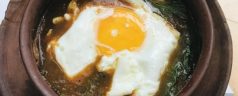
From the first encounter with the hostess, service was warm, welcoming and attentive, without rush nor fuss. Gerardo had prepped me with menu suggestions, and I was sold on the cazuela de huevo y chapulines, a clay pot filled with molten Oaxacan cheese, grilled hoja santa leaf, minced chile-roasted grasshoppers, and a mild but flavorful pasilla salsa. The sunny side up egg served to bind the concoction with glossy yolk. If ever there was a singular dish to introduce one to the prevailing flavors of pre-hispanic Oaxaca- this was it.

Tlayuda en Pasillo de Humo (foto: Jamie Kelly)

Chef Gerardo Alvarado Velázquez

The cazuela was amble but I couldn’t resist ordering a Tlayuda sencilla made with a flour tortilla charred on the comal, cheese and black beans seasoned with epazote and hierba de conejo. The herbs imparted complex flavors that were anything but scencillo (simple). Garnishing the Tlayuda, were slices of radish, pickled red onion, and a long, green seed pod known as guajes. My server happily showed me how to open the pod and pluck out the green, pumpkin seed-shaped morsels. I popped one into my mouth and chewed. It tasted like a starchy pea with the bitterness of clover. Turns out these dangling gems are used, both fresh and dry-roasted, in all manner of Oaxacan salsas, guacamoles, soups, and moles.

Bebida lista en Pasillo de Humo (foto: Jamie Kelly)

My beverage was no less notable. The chepiche mezcal cocktail featured a tangle of feathery, bright green chepiche fronds and sweet, cooling cucumber in a bath of lime, mezcal and mineral water. Curious, I fished a chepiche leaf out of the icy liquid and chewed it. It tasted like cilantro, citrus, and black pepper. The drink was so delicious that I ordered another to drink while writing this account for you.

(Jamie Kelly)

Facebook de Pasillo de Humo

ver ubicación

Av. Nuevo León 107 (9029,65 km); 06100 Ciudad de México (México)

+52 55 5211 7263

Manda huevos, Pasillo de Humo (foto: Jamie Kelly)
Trabajando en Pasillo de Humo (foto: Jamie Kelly)
Un vistazo a Pasillo de Humo (foto: Jamie Kelly)

Momofuku (Las Vegas). David Chang's tarnished halo

I have read about chef David Chang, watched him on TV, made his recipes, and even subscribed to his short-lived culinary magazine. I am a fan. I like his food philosophy, the way he geeks out in the food lab, and honors other chefs and food cultures. But until recently, I’d never eaten in one of his restaurants.

Momofuku in Las Vegas is
undeniably impressive. The moment you transition from the sparkly interior of
the Cosmopolitan, into the dimly-lit dining room of Momofuku, your experience
has begun. An exposed kitchen glows brightly in the dark space. Floor to
ceiling windows frame the tall buildings and strobing lights of the Vegas
Strip.

From the time we were seated, our server was well informed and personable. Service was brisk. in consultation with our server, I ordered sake, oysters with smoked trout roe, Pork Belly Buns, shishito peppers, sweet and sour long beans, and Chang’s famed whole roasted Branzino served over crispy rice and dressed in a “fresh” kimchi.

Oysters with smoked trout roe. Momofuku (photo: Jamie Kelly)

I was thrilled with the
first three picks but to be fair, oysters and shishito peppers rely heavily on
their own merits, requiring only the slightest enhancement. The chewy,
flavor-rich pork belly swaddled in a cloud of steamed dough reflected the Chang
I came to see. But, sadly, that is where the love affair ended.

The long beans were drenched in thick, cloying sauce. But most deflating was the Branzino. Although the fish itself was perfectly cooked, the “kimchi” element offered a mere whisper of flavor—primarily hints of raw cabbage and carrot. There was no acid, no fermentation, no punch. Subtle citrus tones of ponzu seeped into the crispy rice imparting the occasional faint zing. But, overall, the dish was a flavor void in a menu laden with umami-rich options. I suffered deep selection regret that only grew worse as I considered the $80 that I spent on bland fish over rice.

The kitchen of Momofuku (photo: Jamie Kelly)

Chef Chang will never know of my ordering remorse, nor that his signature dish was a dud that tarnished his halo. I want to believe that the shortcomings were kitchen error and that Chang would have prevented the low points in my meal if he had been there. But given the rarity with which he is present in each of his 13 establishments, lack of supervision is the rule, not the exception. I admit that for some chefs I set a high bar. But having seen so many talented individuals soar above my high hopes, it was doubly disappointing for Chang’s Momofuku to fall flat.

(Jamie Kelly)

web de Momofuku Group

ver ubicación

The Cosmopolitan of Las Vegas; Level 2, Boulevard Tower; 3708 Las Vegas Boulevard South; Las Vegas, NV 89109 ; Estados Unidos

Sweet and sour long beans, Momofuku (photo: Jamie Kelly)
Whole roasted branzino. Momofuku (photo: Janie Kelly)
Pork Belly Buns. Momofuku (photo: Jamie Kelly)
Shishito peppers. Momofuku (photo: Jamie Kelly)
Momofuku Las Vegas (photo: Jamie Kelly)

Restaurante Nicos. The true power lunch of Mexico City

When I planned my trip to Mexico City, chef Carlos Ramírez Roure, insisted that I go with him to experience Restaurante Nicos. Always wishing to be a gracious guest, I gleefully obliged.

In its 62nd year and listed 37th among Latin America’s 50 Best Restaurants, Nicos is one of a kind in a city with everything. A one-room, bustling restaurant in the blue collar neighborhood of Azcapotzalco, Nicos is a complete departure from the hyper-styled CDMX dining landscape. It only serves lunch, has a spartan but comfortable space, and offers no cocktails, preferring to feature Mexican spirits and wine. Mezcal is dispensed from a rolling cart and served in traditional jícama gourd cups with sliced oranges and various salts. In the true spirit of showmanship and care, you can enjoy expert tableside preparations of guacamole, Caesar salad, cafe de olla, and salsas individually-crafted to your liking.

The extensive menu designed by the impeccable chef Gerardo Vazquez Lugo pays tribute to the ingredients and recipes of both modern and pre-Hispanic Mexico, diligently researched and sourced. Every detail is deliberate including corn that is nixtalimized in-house for exceptional tortillas.

Quesos de San Miguel de Allende (foto: Jamie Kelly)

We began our exploration with a tableside selection from the roving mezcal cart. Carlos recommended a Pox from Chiapas, a corn-based fermentation. Far from trendy, Pox was commonly used for ceremonial purposes among the Mayans. While we sipped the potent Mayan moonshine, Oscar arrived with the salsa cart and presented the many options. He then set to work, grinding our selection of chiles and tomatoes into a trio of sensational salsas: one jalapeño, one chipotle and a third featuring chile mixe.

The kitchen sent out a unique amuse bouche to set the tone. The chilapita (a small cupped tostada) was topped with mushroom, nopales (cactus), and fresh cheese. This was followed by an avocado roll filled with beef tartar and dressed with radish. To celebrate a solid start to the meal, we selected a mezcal arroqueño, a distillation made from a wild variety of agave that can take up to 20 years to reach maturity. The long wait results in a sweet aroma with earthy flavor.

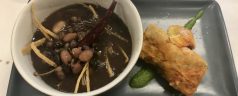
Next, a pairing of bean soup and one of Nicos most renown dishes, sopa seca de nata, arrived together. The bean soup was deliciously seasoned with epazote and served over crisp fried tortilla strips. Yet, its platemate stole the show. The sopa seca, “dry soup”, is a colonial-era casserole that layers crepes in a creamy tomato sauce, somewhat like a lasagna. It was perfectly comforting and decadent, and deserving of its distinction as one of Mexico City’s top bites.

Pacholitas en restaurante Nicos (foto: Jamie Kelly)

We moved to red wine (Gomez Cruzado) as we forged ahead into the entre courses. My favorite dish of the day was a tostada of queso de puerco, a cold, thinly sliced house-made head cheese served over red cabbage and accompanied by a light tomato sauce. It was sublime, melting in my mouth only to leave the essence of pork flavor on my tongue. Next, a plate of the day, pacholitas, arrived. This dish from Jalisco featured a grilled chopped beef steak seasoned and stained red with chile de ancho.

Between courses we noshed on Sourdough bread that was made in Carlos’ own bakery, Sucre y Cacao. It was moist and mellow inside with a tap-worthy crisp crust and required no adornment of oil nor butter. Thanks to the long-standing relationship Chef Carlos has with the owners, in part based on his extraordinary baking talent, I was fortunate to meet both Chef Gerardo and his charming mother, María Elena Lugo Zermeño, who established the restaurant in the 1950s with her own approach to home cooking. Both were warm and welcoming hosts.

Though sensible people would have stopped at this point, I saw something on the menu that begged for my attention: lengua en cuñete. Warm slices of fork-tender beef tongue were submerged in a vibrant white wine escabeche bath. The piquant flavor instigated an immediate mouth-watering deluge that taxed my already exhausted salivary glands.

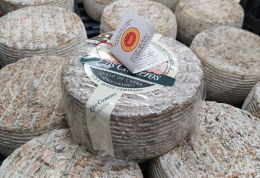
Rather than dessert, we took a journey down a much more exhilarating path involving a bottle of Oaxacan Whiskey Blanco and an assortment of cheeses from San Miguel de Allende. One cheese in particular, was like nothing any cheese I have ever tried. Made with the mosto (spent red grape skins) from the wine harvest, it commanded my full attention with its pungent aroma, sharp as a knife flavor, and chalky texture. It was at once overpowering and alluring.

The parting delight in our 4.5 hour lunch was an assortment of gummies. As if I were not already certain, the joy I found in the pink rose-flavored gelatin heart will endear me to Nicos forever.

(con este texto debuta Jamie Kelly en LQCDM, la weg)

web de restaurante Nicos

ver ubicación

Av. Cuitláhuac 3102; Clavería, Azcapotzalco; 02080 Ciudad de México

Tel: 53967090

Lengua en restaurante Nicos (foto: Jamie Kelly)
Sopa en restaurante Nicos (foto: Jamie Kelly)
Chilapita en restaurante Nicos (foto: Jamie Kelly)
Tarar de carne en restaurante Nicos (foto: Jamie Kelly)